
MRR vs ARR: what each measures, and which one to report
MRR is the recurring revenue your subscriptions bring in a month; ARR is the same over a year, MRR × 12. When each is the right number, and the mistakes to avoid.

MRR, monthly recurring revenue, is what your subscriptions bring in each month. ARR, annual recurring revenue, is the same thing over a year: Stripe calculates it as MRR × 12. A customer on a $1,200 yearly plan adds $100 to your MRR and $1,200 to your ARR. Same base, two scales: MRR shows how you are doing this month, ARR how big the business is.
The difference, side by side
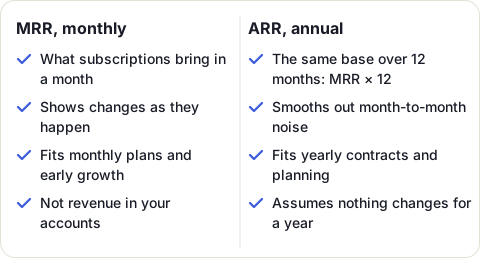
Both count only the recurring part of your income. Both leave out one-off invoices such as setup fees, taxes, and in Stripe’s count, usage-based prices, trials and free plans. And neither is the revenue in your accounts: Stripe says plainly that MRR is not GAAP revenue. It is a measure of the income you can predict.
When MRR is the better number
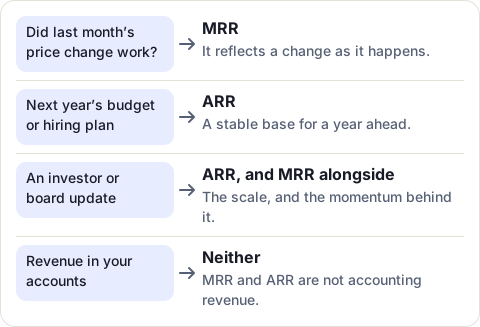
Stripe’s guide puts it this way: MRR is sensitive to recent changes and shows momentum quickly. Use it when:
- You bill monthly. Your numbers move on the same rhythm as your billing.
- You are still finding what works. A price change, a new plan or a campaign shows up in MRR as it happens.
- You watch churn. Cancellations and downgrades show up in MRR before they change a yearly figure.
Stripe also splits each change in MRR into what moved it, such as new subscriptions, upgrades and churn: see how MRR changes from one month to the next.
When ARR is the better number
ARR smooths out the month-to-month movement and shows how large and stable the revenue base is. Use it when:
- You sell yearly or multi-year plans. ARR follows how your customers commit.
- You plan ahead: a yearly budget, a hiring plan, growth targets.
- You report to investors or a board. ARR is the summary of scale they expect, a shared language for investors and boards.
Keep in mind what ARR assumes: that your current customers, prices and contracts stay the same for twelve months. It is a snapshot multiplied by 12, not a forecast of what you will collect.
How to convert one into the other
- MRR to ARR: multiply by 12.
- ARR to MRR: divide by 12.
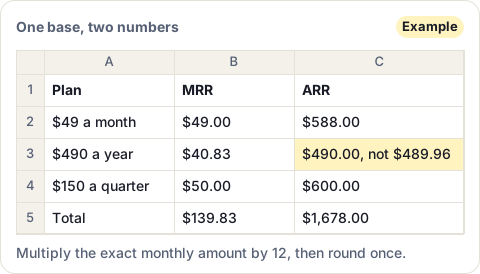
- A yearly plan: divide its price by 12 for MRR. Its ARR is its price.
- A quarterly plan: divide by 3 for MRR, multiply by 4 for ARR.
One trap: round once, at the end. A $490 yearly plan is $40.8333… a month. If you round MRR to $40.83 first and then multiply by 12, ARR comes out as $489.96 instead of $490.00. Over hundreds of yearly customers, the cents add up to a number nobody can explain.
Mistakes that make MRR and ARR wrong
- Counting what MRR leaves out: trials, free plans, or a yearly invoice all in the month it is paid.
- Adding up invoices. Invoices include one-off charges and taxes, and miss yearly plans in the months they aren’t billed. Stripe warns that MRR can’t be calculated by adding up invoice totals.
- Multiplying one good month by 12. If that month included one-off invoices, the ARR you get will never be collected.
- Mixing two definitions. If one report subtracts discounts and another doesn’t, the numbers won’t agree. Pick one and write it down.
For the exact rules Stripe applies (past-due subscriptions, trials, discounts, cancellations at period end), see how to calculate MRR from your Stripe subscriptions.
Sources
- Stripe Support: Understanding Monthly Recurring Revenue (MRR) and Annual Recurring Revenue (ARR), read 20 November 2026
- Stripe Resources: How to use MRR and ARR to guide growth, read 20 November 2026
- Stripe Docs: Supported metrics, read 20 November 2026
Frequently asked questions
What is the difference between MRR and ARR?
MRR, monthly recurring revenue, is what your subscriptions bring in each month. ARR, annual recurring revenue, is the same over a year: MRR × 12. They describe the same base at two scales.
How do you convert MRR to ARR?
Multiply MRR by 12. To go back, divide ARR by 12. Do it with the exact amounts and round once, or a yearly plan can lose a few cents.
Is MRR gross or net?
It depends on how you treat discounts. In Stripe you choose whether recurring discounts, one-time discounts, or both are subtracted from MRR. Taxes are never part of it.
Is MRR the same as revenue?
No. MRR is not accounting revenue. It measures the predictable part of your income from subscriptions, and leaves out one-off charges, taxes and usage-based prices.
Do one-time fees count in MRR or ARR?
No. Setup fees and other one-off invoices don't recur, so they stay out of both.